API Overview
Go to the main Easy API section via your CP sidebar menu. You’ll be presented with a table listing of your saved APIs, or none if you haven’t set any up yet. Setup is very similar to a feed in FeedMe, with the addition of being able to select parent elements and parent element groups.
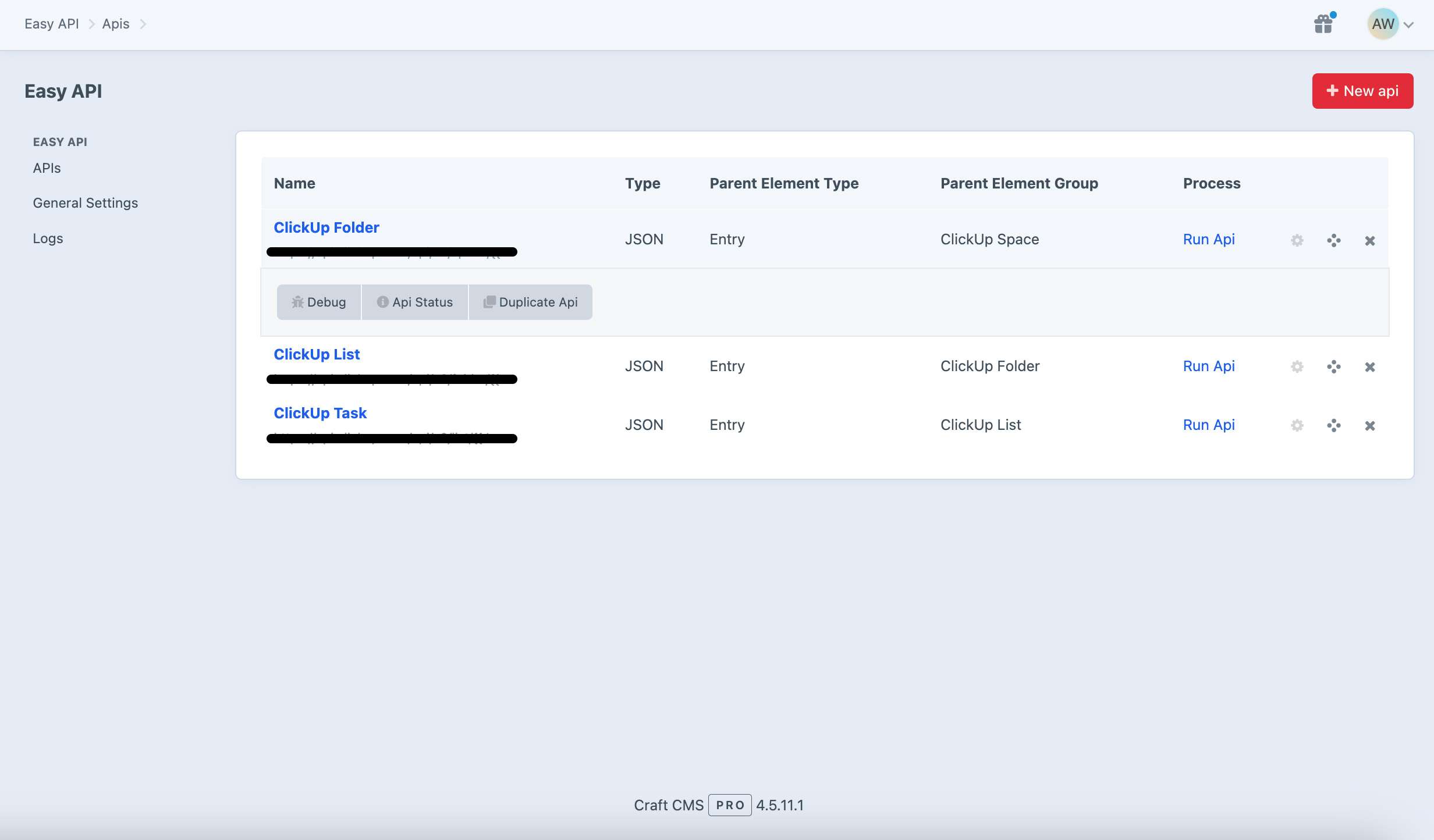
This overview shows the following (field handle for configuration in brackets):
- Name (
name) - Name your API something useful so you’ll remember what it does. - API URL (
APIUrl) The URL to the external API. - Type (
contentType) - The data type you’re importing. - Parent Element Type (
parentElementType) - The element type you are linking the imported data to. - Parent Element Group (
parentElementGroup) - Depending on the parent element type chosen. Entries will show Section/Entry Type, Categories will show Group, etc. - Element Type (
elementType) - The element type you are importing into. - Element Group (
elementGroup) - Depending on the element type chosen. Entries will show Section/Entry Type, Categories will show Group, etc. - Strategy (
duplicateHandle) - What import strategy you have chosen: how you’d like to handle duplicate API items (if you’re going to be re-running this API). - Run API - Queues the API for import and returns immediately (see Running an API below)
- Settings (icon) - Additional settings pane (see below).
- Delete (icon) - Delete this API (be careful).
Settings Panel
Clicking on the settings cog icon will expand additional settings for each API.
- Debug API - Opens in a new window and runs the Debug action.
- API Status - Takes you to an overview screen showing the process of your API if currently running.
- Duplicate API - Duplicates this API and all settings into a new API.
Create a new API by pressing the red + New API button in the top-right, or click on the Name column in your table. You’ll then be taken to “Create your API”.
Running an API
Clicking Run API pushes the import onto Craft’s queue and spawns a detached php craft queue/run process, so the import executes in the background and the page returns immediately rather than waiting for the run to finish. This matters most for parent-based APIs, which may make hundreds or thousands of sequential API calls. Monitor progress under Utilities → Queue Manager or in the Feed Me logs.
Feed Me jobs pushed by Easy API are given a queue time-to-reserve (TTR) of 14400 seconds by default so long imports aren’t restarted mid-run. You can override this with a config/feed-me.php file setting queueTtr.
For an API to run through Feed Me’s queued import, its feed must have a field mapping configured. APIs without a field mapping run through the direct path instead, which executes any configured post-import handlers without mapping data into elements.
Console commands
APIs can also be queued or run from the command line, which is recommended for very large imports:
# Queue the API as a background job (executes via your normal queue worker)
php craft easyapi/apis/queue <apiId>

# Run the API directly in the console, bypassing the queue
php craft easyapi/apis/run-direct <apiId>
run-direct executes the same feed pipeline as a queued run (including parent element looping and post-import handlers), so it’s a reliable way to run large parent-based imports with visible output.
Feed Me setup screens
When stepping through Feed Me’s feed setup screens (primary element and field mapping), only the first 5 parent elements are requested. These screens only need a representative sample of the data to enumerate available fields, so your full parent set is not looped during configuration. Full runs still process every parent element.